Components
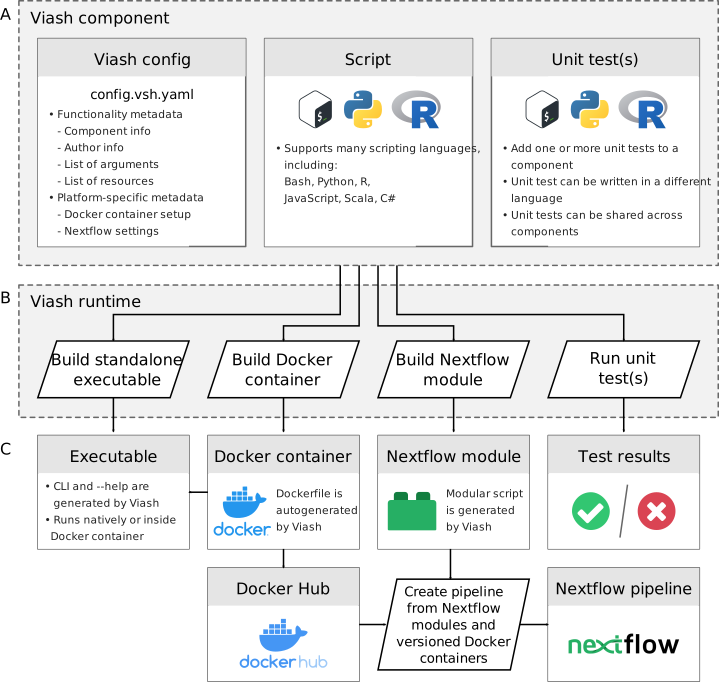
A Viash component is a combination of a code block or script and a small amount of metadata that makes it easy to generate pipeline modules, facilitating the separation of component functionality from the pipeline workflow (Cannoodt et al., 2021). This enables developers to create reusable, modular, and robust components for OpenProblems, focusing on the specific functionality without having to worry about the chosen pipeline framework.
A Viash component consists of three main parts: a Viash config, a script, and one or more unit tests.
Example component
Section titled “Example component”When creating a new Viash component, you will need to create a script and a config file. Below is an example of a simple Viash component written in Python. For a detailed explanation of the structure of a Viash component in more programming languages (Bash, Python, R), please review the Viash component guide.
Script
Section titled “Script”To help with prototyping, a Viash component’s script should be runnable standalone. You can do this
by defining a Viash placeholder code block
denoted by ## VIASH START and ## VIASH END comments.
The placeholder should contain a dictionary (or named list) with example values for all input/output arguments. During execution, Viash removes the placeholder and replaces it with the actual parameter values at runtime.
import anndata
## VIASH START# Note: This codeblock is for prototyping and# is removed by Viash at runtime.par = {  'input': 'test_resource.txt',  'output': 'output.txt'}## VIASH END
# Print parprint(f"par: {par}")
# Read input fileadata = anndata.read_h5ad(par["input"])
# Print adataprint(f"adata: {adata}")
# Write output fileadata.write_h5ad(par["output"])Viash config
Section titled “Viash config”name: mycomponentlabel: My Componentsummary: A short summary of the component.description: | A multiline description.arguments: - name: "--input" type: file description: Input h5ad example: input.h5ad required: true - name: "--output" type: file direction: output description: Output h5ad example: output.h5ad required: trueresources: - type: python_script path: script.pytests: - type: python_script path: test.pyengines: - type: docker image: "python:3.10" setup: - type: python pypi: anndatarunners: - type: executable - type: nextflowComponent format specifications
Section titled “Component format specifications”OpenProblems tasks contain specifications for the common config fields shared between the same
component types. These specifications are defined in src/api/comp_*.yaml files. For more
information on how these specifications are formatted, see
Design the API.
- Cannoodt, R., Cannoodt, H., Van de Kerckhove, E., Boschmans, A., De Maeyer, D., & Verbeiren, T. (2021). Viash: from scripts to pipelines. arXiv. 10.48550/ARXIV.2110.11494 ↗